“The reason I talk about this is that the younger composer has no comprehension of work. And I feel that that’s the door! That you could only become close by this continual work, close or distant, whatever it is to continue. I know as a teacher…I developed a kind of moral responsibility of seeing all these dead bodies from generation to generation. Now, it’s not because they have no ideas or they don’t have talent, but it’s because the amount of work that really goes into writing a piece is incomprehensible to them.”
– Morton Feldman, 1986
“It does not matter how slow you go so long as you do not stop.”
– Confucious
I’m able to participate in somewhat sporadic ‘free improv jam sessions’ (including but not limited to my participation in the New Haven Improvisers Collective), and I had the presence of mind to document the most recent one, on a chillaxed Saturday morning with a very talented neighbor of mine.
A mini-blog series seemed like a good idea, because the process of how we interpreted the pieces was interesting (in my opinion – I went years without really knowing how to approach a graphic score).
Also, I get to share some good online resources for finding scores and such, which I love doing.
So let’s go!
My partner in crime was my neighbor David Elkin-Ginnetti, a young man who is great at music, great at math, and remains impossibly humble and cool. Remember that name, the kid is going places! Maybe someday he’ll let me play in his band…
Brockmann
We warmed up with the “Pitch Match” game from Nicole Brockman’s From Sight to Sound: Improvisational Games for Classical Musicians. The instructions are pretty simple: one person sustains a note, the other participants try to find and sustain the same note. When everyone has got the note, somebody else plays a new note. It’s fun, surprisingly engaging, and a little challenging (I found myself sometimes matching the major third instead of the same note).
Agrell
Once we had gotten our ears tuned, we tackled our first improv. I am working my way through Jeffrey Agrell’s “Improv Games for One Musician,” which is a brief but deep volume of games to get people “off the page” and making music. It’s aimed towards classical musicians and fledgling improvisers, but this grizzled greybeard finds it be a great source of warm-ups and games also.
Below you can find our take on Agrell’s “Interval Game,” where the performer limits their material to certain intervals – fourths and fifths, or tritones and 7ths, etc., and creates an improvisation. It’s suitable for solo performers but also duos (and trios), so David and I stretched our muscles with a short improv that limited our pitch materials to major and minor 7ths, augmented fourths, and the inversions of major and minor 7ths: major and minor 2nds:
(note that for each of us the intervals were constrained to our own instrument – in other words, I didn’t try to play a 7th above the tone my partner played…though that would be very cool!)
I’ve done this on my own as a warm-up and found the limiting of pitch materials to be a great unifying force. I’ve read a lot of great creatives saying that the more constraints on a piece has, the more creative they are.
My favorite quote was Stravinsky saying along the lines of “If you put a piece of blank paper in front of me, I’ll be frozen with fear. But if you put tell me that I must write for four cellos, then the ideas will fly from my fingers onto the page.”
And that was Stravinsky!
But of course, too many constraints or constraints that never change can get a little dull. So, in our next post, I’ll share how we turned into Agrell’s exercises into an improv with ABA form.
Pleased as punch to announce my new EP, Only Numbers Remain, is now available!
This EP combines my interests in free improv and drum and bass music with a super-nerdy classical interest in Schoenberg’s 12-tone serialism.
This is project gestated for a long time – I was inspired by reading free jazz guitarist Derek Bailey’s (surly and hilarious) account of recording a free jazz guitar/drum and bass collaboration. (Once long-lost, now easily available on the intermanets).
I worked out a system of improvising over 12-tone rows and layed out some basic D&B tracks in Ableton live. Then I roped in <A HREF=”http://barryseroff.net” target=new>Barry Seroff</A>, one of my favorite musicians, to play on the album. We spent a sunny afternoon improvising over 12-tone rows (and wrestling with equipment)…and then I started teaching and my life was totally consumed.
This past summer I resolved that I was finally going to release this thing, and I utilized the masterful mixing services of Dave Brenneman (I love making music, I hate mixing. Dave makes beautiful mixes effortlessly (or it seems effortless to me at least).
And there we have it. A 5-song EP that’s very weird and a little jarring, and I’m very proud of it!
Just a note that I’m launching my new blog, Composing My Way through History, with a description of Mycenaean Music (the civilization which juuuuuuuuuust pre-dated ancient Greece). It’s fun – I’m looking forward to this project a bit (once I manage to scale back my other projects!)
Next I need to be the first assignment, which will be creating compositions for the aulos:
This summer I’ve been working through the MIT OpenCoursewar class on Making Music with Computers, mostly in preparation for an electroacoustic baritone horn piece, but also just for fun. I just finished this piece, in which I recorded 2 minutes of traffic and wind sounds from my backyard, drew a graphic score with squiggles and blobs to represent what it sounded like, and then re-recorded it using snippets of sounds from around the house (the end result didn’t have to sound like the source material at all). It was a blast!
And now for something a bit lighter than what has been going on the past few days – I’ll be playing tunes from the great American songbook with Beth Patella at the Outer Space in Hamden — tonight!
Sunday, August 5th, 6:00-7:00p.m.
The Outer Space
295 Treadwell Street
Hamden, CT 06514
We’ll be sharing the bill with Phil Giampetro’s duo – euphonium and piano! Love it!
In my previous blog entry, “Selling Us Back to Ourselves”, I described how the act of making of music once belonged to all of us — and was subsequently taken from us and transformed into an “expert’s” activity, the product of which was sold back to us.
We ended with the question: “When did we lose our belief that everyone can make music?”
I don’t know the definitive answer, but my semi-educated guess says it was a long process that began in the 1930’s – probably with the advent of records and later TV.
Before phonograph records were widely available (if any of my students are reading this, look to your left), people who wanted to experience music had two options:
1) perform it themselves
2) go see it performed live (probably within walking/bus distance).
But once records and TV became commonplace and affordable, there was a sea change in the way we experienced music – music was now something we passively listened to instead of played, performed, or made. The “average consumer” consumed music, instead of producing it on parlor pianos, ukuleles, or what have you. The people who produced music were “professionals,” ranging from Sinatra’s backing band to shaggy-haired rockers. Music became centralized, and then distributed to the masses (at a profit, they hoped).
Nerdvana
And in 1950’s post-war America, we may have damn well liked it that way – consumerism may not have been the dirty word it is today. In my last post, I described how musicologist Christopher Blacking proposed that before the second world war, we judged by how “sociable” it was; a music historian I’m reading now, Richard Taruskin, says that this value was “tyrannically abused under totalitarian regimes” during World War II — in other words, totalitarian regimes used music for propaganda. The history of classical composers sanctioned or blacklisted by oppressive regimes is pretty well-documented; apparently these regimes also used popular music and songbooks also (I can find references to these songbooks but not actual examples).
These regimes celebrated “the people” as a means to mercilessly control the people. Following Taruskin’s logic, music that was created by “the people” may have rang suspicious to those who survived the war; it may have seemed a little too reminiscent of those totalitarian regimes. It’s no coincidence that after the war, serious classical composers began creating impenetrably complex music. Accessibility was no longer important to them; judging a piece on whether or not it was “for the people” smacked of Communism and Socialism.
And in America, flush with a post-war economic boom, it’s possible that our love of capitalism made us, in our own way, skeptical of music that could be made communally. Communal music wasn’t a *product*, and here in America we love *products*. *Amateurs* made communal music, but a teenager could by a record made by “professional” musicians with their allowance money.
In the No-Wave documentary Kill Your Idols, Arto Lindsay discusses the weirdness of today’s record industry taking youth culture and selling it right back to young people. He’s discussing rock and roll, but that quote applies to music on the whole. The ability to make music used to be “ours,” even if it was as simple as singing a song from the folk tradition while we do housework. But now we perceive the ability to make music as belonging to an elite few.
Up next, a shout out to those who are keeping our traditional music alive – and what does “our traditional music” even mean in the US?
Quick – how many folks songs do you know and can you sing right now?
Follow-up, just as quick: How many of them are considered children’s songs?
I recently had a chat with a coworker about the importance – and enjoyment – of singing. Not in a chorus, but casually and in a group. How his school had weekly singalongs with students, parents, and staff, and how much fun it was. How in my neighborhood we have sporadic but semi-regular neighborhood singalongs (you could call it a “hootenanny”), with food, guitars, and whatever other instruments happen by. It’s awesome.
But I’ll bet that most Americans don’t have informal community singalongs and don’t make music with each other for fun.
As a music teacher, this of course upsets me.
As a human being, this upsets me!
Because when you look at it, our *lack* of communal music-making is a weird anomaly in Western history. And it’s fairly recent (and I hope short-term) anomaly. I read an interview with the classical composer Milton Babbitt, and he said that when he was growing up in the 1920’s, *everyone* played ukulele. Jazz Pianist Billy Taylor described a childhood where everybody could sing and play one or two songs on piano – and they didn’t consider themselves musicians, they were just people who enjoyed music.
And this kind of situation – where everybody is as capable of making music as they are of talking – is apparently they norm, fairly universally. I just came across ethnomusicologist Christopher Blacking, who spent two years conducting fieldwork among South African tribespeople, and he reports that in most sub-Saharan African societies, everyone is considered a “musician,” in that “they are able to perform and listen intelligently to their own indigenous music.”
Blacking hypothesizes that music, throughought the rest of human history, was assessed by the degree to which it furthered social harmony – in other words, if a song lends itself to people getting together and singing and playing it for fun, the community judged it as “good.” If it was ill-suited for community music-making, the song was bad. (tough luck, dubstep.).
Does that describe American society now? Nope. When did we lose our belief that everyone can make music?
Coming tomorrow – my best-guess answer, and what we can do about it.
Remixing tracks has turned out to be a great step for my career, such as it is (certainly better for my career than my usual chin-stroking tomfoolery).
Right now I’m really digging being in the middle of working on two tracks from two very cool artists.
Today: The LeBoeuf Brothers.
The LeBoeuf Brothers are jazz-playing twins. BUT WAIT THERE’S MORE! Their most recent album, In Praise of Shadows, is a doubly-made album – they initially tracked it as a modern jazz album…then they went in and remade all the tracks from the angle of electronic music.
And it sounds cool:
Then they opened it up for remixes, so I got to remix a remix!
Working on a track like this is almost hard because there’s so much great material to work with. If I was working on, say, a techno track with just one hook, remixing would be easy – I’d keep the hook and rebuild the rest.
I read somewhere that creativity is about making choices and eliminating your options until you’re left with the final product. Working on this track, D2D, was a lot like that – picking the parts to keep was a series of very difficult decision! There was so much good stuff in there, it pained me that I could only pick a few to work with.
(and props to their bassist Linda Oh, who always provided this remixer with musical gold.)
I’ve sent the track off, so hopefully it will be a worthy contribution to the remixed remixes.
I loved this post on Creating and Editing from J. Robert Lennon, who is probably one of my most impressive internet friends and YOU GUYS HE IS AN AWESOME WRITER AND GUYS ONE TIME I GOT BURRITOS WITH HIM (and he eats a burrito just like you would expect a writer to. Like…metaphorically.)
Anyway, it’s a great article that is supposedly about writing fiction collaboratively, but is actually about how being a creative person means you’re on a team – with two versions of yourself.
Lennon describes the first version as “the one who is able to suppress the fear and self-disgust that can derail any creative effort.” Sounds wonderful! And the second one version of yourself? “The [second one] one … is able to dismiss inspiration as so much bullshit, and brass-knuckle a manuscript into shape.”
Oh.
Years ago I think I read something where Quincy Jones said he got some very similar advice from Duke Ellington, and it is really the best advice for any individual involved in a creative pursuit. I am ALWAYS telling my students that there’s two stages to the creative process: 1) Getting all your ideas out 2) Going back and editing all those ideas into something good.
Note that you are not to assess the value of ANYTHING in stage 1!!! If it’s in your head, you write it down (or record it or notate it or whatever). Don’t worry about if something is “good” until stage 2.
Stage 1 is what your English teachers called the rough draft. In private, away from your delicate ears, they refer to it as the “crap draft.” You are literally pulling anything from your head that you think may be relevant and just barfing it all onto the page.
THEN, in stage 2, you go through and cut out what’s irrelevant and keep what looks good.
(Weirdly, I’m pretty good at this when recording music in my studio. But now that I’ve started studying classical composition, I’m finding I need to re-apply this procedure to my new workflow. )
Anyway, J. Robert Lennon is smart. Read the article. Also, his fiction is hilarious, irreverent, clever, and at times quite haunting. Check out a book of his short fiction, Video Game Hints, Tricks, and Cheats, from his website. Or buy his books from Amazon.



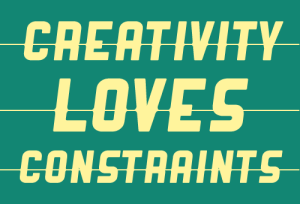 My favorite quote was Stravinsky saying along the lines of “If you put a piece of blank paper in front of me, I’ll be frozen with fear. But if you put tell me that I must write for four cellos, then the ideas will fly from my fingers onto the page.”
 Sunday, August 5th, 6:00-7:00p.m.
 Before phonograph records were widely available (if any of my students are reading this, look to your left), people who wanted to experience music had two options:
 And in America, flush with a post-war economic boom, it’s possible that our love of capitalism made us, in our own way, skeptical of music that could be made communally. Communal music wasn’t a *product*, and here in America we love *products*. *Amateurs* made communal music, but a teenager could by a record made by “professional” musicians with their allowance money.
 Because when you look at it, our *lack* of communal music-making is a weird anomaly in Western history. And it’s fairly recent (and I hope short-term) anomaly. I read an interview with the classical composer Milton Babbitt, and he said that when he was growing up in the 1920’s, *everyone* played ukulele. Jazz Pianist Billy Taylor described a childhood where everybody could sing and play one or two songs on piano – and they didn’t consider themselves musicians, they were just people who enjoyed music.
 And this kind of situation – where everybody is as capable of making music as they are of talking – is apparently they norm, fairly universally. I just came across ethnomusicologist Christopher Blacking, who spent two years conducting fieldwork among South African tribespeople, and he reports that in most sub-Saharan African societies, everyone is considered a “musician,” in that “they are able to perform and listen intelligently to their own indigenous music.”
 nate trier